Professor of Mathematics and AI, Lancaster University
Point vortices of both signs in a disc, each mirrored by an image vortex beyond the wall.
Raise the mutual friction and dipoles shrink and annihilate while lone vortices drift out.
Click inside the disc to add a vortex.
Quantum fluids research, related paper
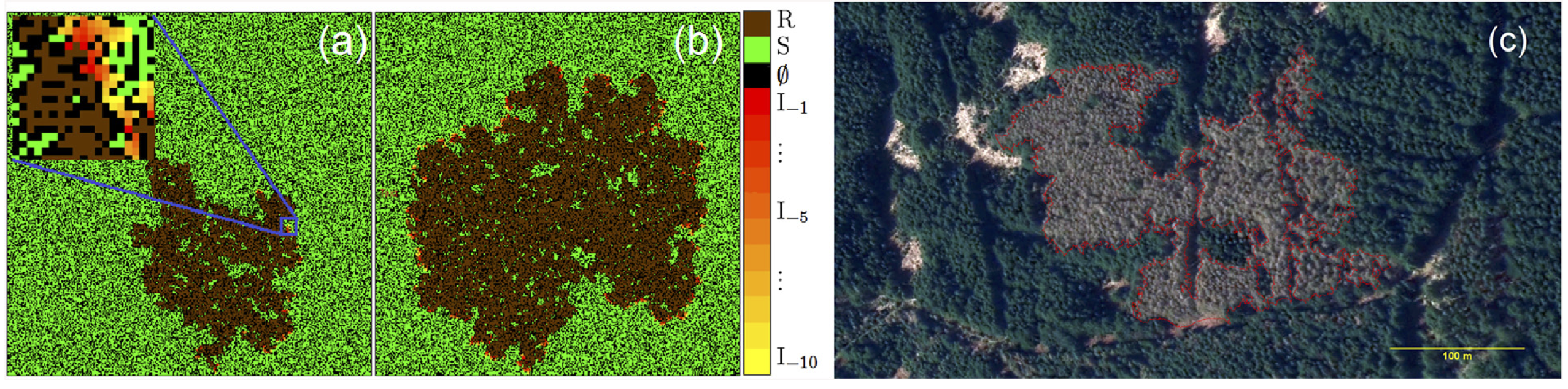
A stochastic SIR model of a planted forest: each tree is susceptible, infected or removed, and infection
jumps a short distance to its neighbours. Above a critical planting density a local outbreak becomes an epidemic.
Click a tree to infect it.
Maths biology research, related paper
Learning where a disease spreads easily from sparse data. An outbreak moves through a landscape whose
transmission varies in space, but all we observe is a survey of which sites are infected. A generative
diffusion model starts from pure noise and removes it step by step, ending with a map of transmission
consistent with the survey. Each sample differs most where the outbreak has not reached, which is where the
data say least. Here a simple stand-in plays the part of the trained neural network.
Maths biology research
Bottom-heavy swimming algae in the ABC flow, a classic chaotic three-dimensional flow, shown in one periodic
cell. Gyrotaxis, the torque that turns the cells upright against gravity, gathers them into helical plumes
and suppresses the chaotic mixing that passive particles feel. As the swimming speed rises, chaos is
suppressed, returns for speeds just above the flow speed, and is suppressed again, as the inset shows.
Drag to rotate.
Maths biology research, related paper
A single quantised vortex in superfluid helium, simulated with the vortex filament model. Helical Kelvin
waves are driven at the longest wavelengths; their nonlinear interactions pass energy to ever shorter waves
until it is lost at the smallest scales, where a real vortex radiates sound. Darker blue marks small-scale
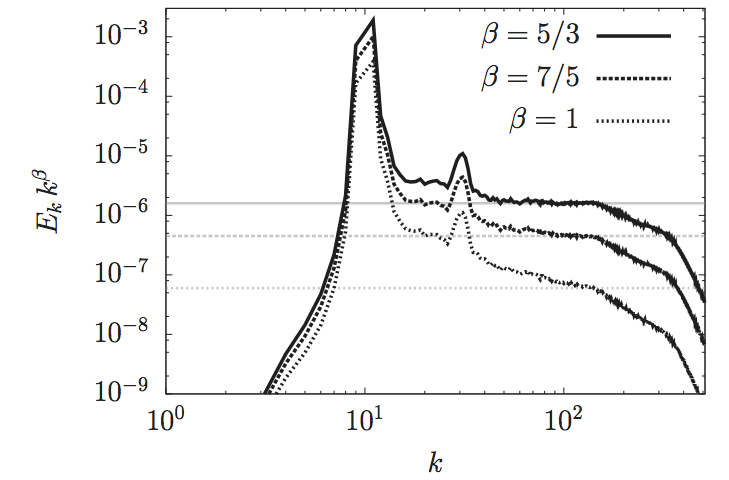
waves. The inset compares the spectrum with the two rival predictions, L'vov and Nazarenko's
k−5/3 and Kozik and Svistunov's k−7/5; this small simulation is too short
in range to tell them apart, which took the much larger simulations of our 2014 paper. Turn the forcing off
to watch the cascade decay, or pluck the vortex as a reconnection would. Drag to rotate.
Quantum fluids research, 2014 paper, Viewpoint in Physics
About
I am Professor of Mathematics and AI in MARS: Mathematics for AI in Real-world Systems, part of the School of Mathematical Sciences at Lancaster University, where I am Director of Studies for the MARS degree programme.
My main research interest is turbulence in quantum fluids such as superfluid helium and atomic Bose–Einstein condensates, and how it compares with the classical turbulence we are more familiar with. I also work in mathematical biology, especially the spread of tree and plant disease, combining stochastic epidemic models with statistical and machine-learning inference, and I keep a long-standing interest in mathematical archaeology.
I am always on the lookout for strong PhD students and postdoctoral researchers, and I often have openings for undergraduate summer students. If you are a current student and see me online in Teams, feel free to message or call.
Turbulence in superfluid helium and atomic Bose–Einstein condensates: vortex reconnections, Kelvin-wave cascades, coherent vortex bundles and the motion of point vortices in two dimensions, studied with vortex filament and Gross–Pitaevskii simulations.
How tree and plant diseases spread through landscapes, and how to fit stochastic epidemic models to sparse survey data, alongside collective animal motion, stem cell colonies and the spread of farming in Neolithic Europe.
I take over as lead of the MARS section in the School of Mathematical Sciences.
Sep 2026
My Viewpoint in Physics, The turbulent life of a vortex line, discusses new experiments giving the first direct evidence of the six-wave interactions thought to drive Kelvin-wave turbulence.
Aug 2026
Learning spatial transmission maps from sparse outbreak snapshots with diffusion models is to appear in the Journal of the Royal Society Interface.
@article{baggaley2026turbulent,
  title = {The turbulent life of a vortex line},
  author = {A. W. Baggaley},
  journal = {Physics},
  volume = {19},
  pages = {118},
  year = {2026},
}
@article{stasiak2025experimental,
  title = {Experimental and theoretical evidence of universality in superfluid vortex reconnections},
  author = {P. Z. Stasiak and Y. Xing and Y. Alihosseini and C. F. Barenghi and A. W. Baggaley and W. Guo and others},
  journal = {Proceedings of the National Academy of Sciences},
  volume = {122},
  pages = {e2426064122},
  year = {2025},
  doi = {10.1073/pnas.2426064122},
}
I. K. Liu, A. W. Baggaley, C. F. Barenghi, and T. S. Wood.
Vortex avalanches and collective motion in neutron stars. The Astrophysical Journal 984, 83
(2025).
BibTeX
@article{liu2025vortex,
  title = {Vortex avalanches and collective motion in neutron stars},
  author = {I. K. Liu and A. W. Baggaley and C. F. Barenghi and T. S. Wood},
  journal = {The Astrophysical Journal},
  volume = {984},
  pages = {83},
  year = {2025},
}
L. E. Wadkin, J. Holden, R. Ettelaie, M. J. Holmes, J. Smith, A. Golightly, and A. W. Baggaley.
Estimating the reproduction number, R₀, from individual-based models of tree disease spread. Ecological Modelling 489, 110630
(2024).
BibTeX
@article{wadkin2024estimating,
  title = {Estimating the reproduction number, R₀, from individual-based models of tree disease spread},
  author = {L. E. Wadkin and J. Holden and R. Ettelaie and M. J. Holmes and J. Smith and A. Golightly and A. W. Baggaley},
  journal = {Ecological Modelling},
  volume = {489},
  pages = {110630},
  year = {2024},
}
A. Golightly, L. E. Wadkin, S. Whitaker, A. W. Baggaley, N. G. Parker, and T. Kypraios.
Accelerating Bayesian inference for stochastic epidemic models using incidence data. Statistics and Computing 33, 134
(2023).
BibTeX
@article{golightly2023accelerating,
  title = {Accelerating Bayesian inference for stochastic epidemic models using incidence data},
  author = {A. Golightly and L. E. Wadkin and S. Whitaker and A. W. Baggaley and N. G. Parker and T. Kypraios},
  journal = {Statistics and Computing},
  volume = {33},
  pages = {134},
  year = {2023},
}
@article{galantucci2023dissipation,
  title = {Dissipation anomaly in a turbulent quantum fluid},
  author = {L. Galantucci and E. Rickinson and A. W. Baggaley and N. G. Parker and C. F. Barenghi},
  journal = {Physical Review Fluids},
  volume = {8},
  pages = {034605},
  year = {2023},
  doi = {10.1103/PhysRevFluids.8.034605},
}
S. Orozco-Fuentes, G. Griffiths, M. J. Holmes, R. Ettelaie, J. Smith, A. W. Baggaley, and N. G. Parker.
Early warning signals in plant disease outbreaks. Ecological Modelling 393, 12–19
(2019).
@article{orozcofuentes2019early,
  title = {Early warning signals in plant disease outbreaks},
  author = {S. Orozco-Fuentes and G. Griffiths and M. J. Holmes and R. Ettelaie and J. Smith and A. W. Baggaley and N. G. Parker},
  journal = {Ecological Modelling},
  volume = {393},
  pages = {12--19},
  year = {2019},
  eprint = {1802.07562},
  archivePrefix = {arXiv},
}
Matthew Richardson(PhD student, Newcastle, from 2024) Technological applications of Bose–Einstein condensates
Axa-Maria Laaperi(PhD student, Newcastle, from 2023) Mathematical and statistical models of wildfires
Julie Thomas(PhD student, Newcastle, from 2022) Superfluid dynamics in neutron stars
Jamie McKeown(PhD student, Newcastle, from 2022) Resilient treescapes: a mathematical approach
I am happy to supervise PhD projects in quantum fluids and turbulence, in mathematical biology and plant health, and at their interfaces with statistical inference and machine learning. Projects can lean towards large-scale simulation, towards modelling and analysis, or towards inference from data. Please get in touch to discuss ideas. Former students and postdocs are listed on my Bio page.