
Mathematical biology
The biological world provides many lifetimes of interesting phenomena, so it is no surprise that mathematical biology is an active, diverse and important field; my interests span several parts of it. I am interested in the interaction between fluid motion and microbial or animal behaviour, including gyrotactic organisms in complex flows, and how underlying fluid motion can help us understand collective motion such as bird flocks.
More recently I have become involved in a number of projects to understand the spread of tree disease in UK forests. This is particularly motivating, as a series of silent pandemics in tree and plant species poses a massive threat to humanity and our current way of life. Mathematical modelling can provide insight into how to plan, how to react, and how to inform policymakers. Current work combines stochastic epidemic models with statistical and machine-learning inference, from tracking the oak processionary moth across the UK to learning spatial transmission maps from sparse outbreak snapshots with generative diffusion models. The diffusion model animation on the home page sketches how the second of these works.
Finally, I am interested in understanding the spread of farming in the Neolithic using mathematical modelling. Contributions I believe are important to the field are highlighted below.
Research highlights
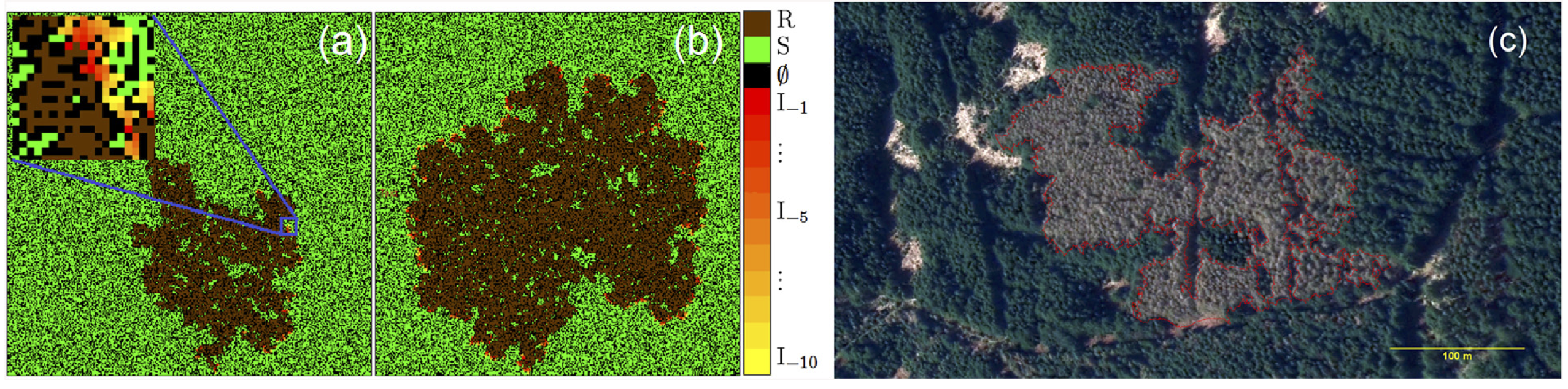
Early warning signals in tree disease
Native trees are under constant threat from alien pests and diseases, as exemplified by recent outbreaks affecting ash and sweet chestnut. Such outbreaks have massive social and economic impacts and motivate the need for suitable planning and management. Climate change exacerbates the threat by promoting the migration, survival and growth of alien pathogens, and the Department for Environment, Food and Rural Affairs (Defra) has highlighted the importance of modelling in developing robust plans and policies to minimise their impact.
In a recent paper we used the framework of early-warning indicators for impending regime shifts, widely applied to dynamical systems, to study the transition from confinement of a forest disease to a catastrophic outbreak. Our study shows that early-warning indicators can predict forest disease epidemics, and may also help to identify a planting density that slows the spread of disease. The tree disease animation on the home page is a simple version of this model.
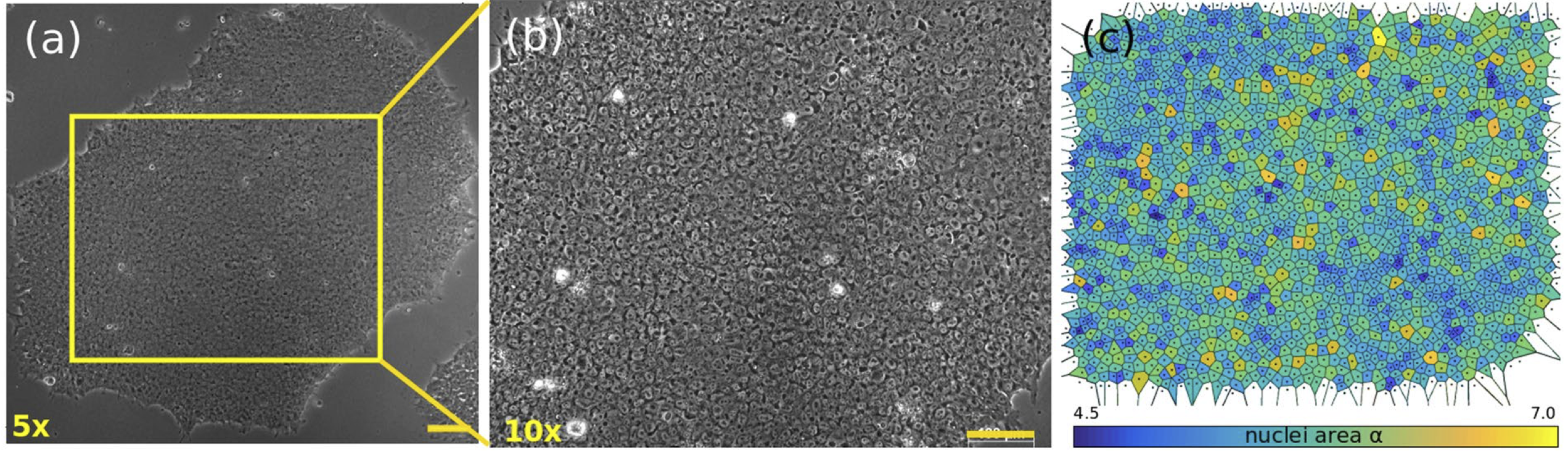
Stem cell colonies
Stem cells are at the forefront of modern biological research. Human embryonic stem cells (hESCs) are pluripotent: they can differentiate into all tissues of the body, and it is hoped that stem-cell therapies may one day treat life-changing illnesses. In lab-grown colonies, maintaining undifferentiated cells is critical for regenerative medicine, drug testing and fundamental biology. At present the best cells and colonies are usually selected by eye, relying on expertise to identify features such as a tightly packed appearance and a well-defined edge. In a recent study we developed a methodology using image analysis and computational modelling to quantify these properties. The findings help explain the biological processes behind high-quality hESC colonies and establish a database of colony characteristics to guide future studies.
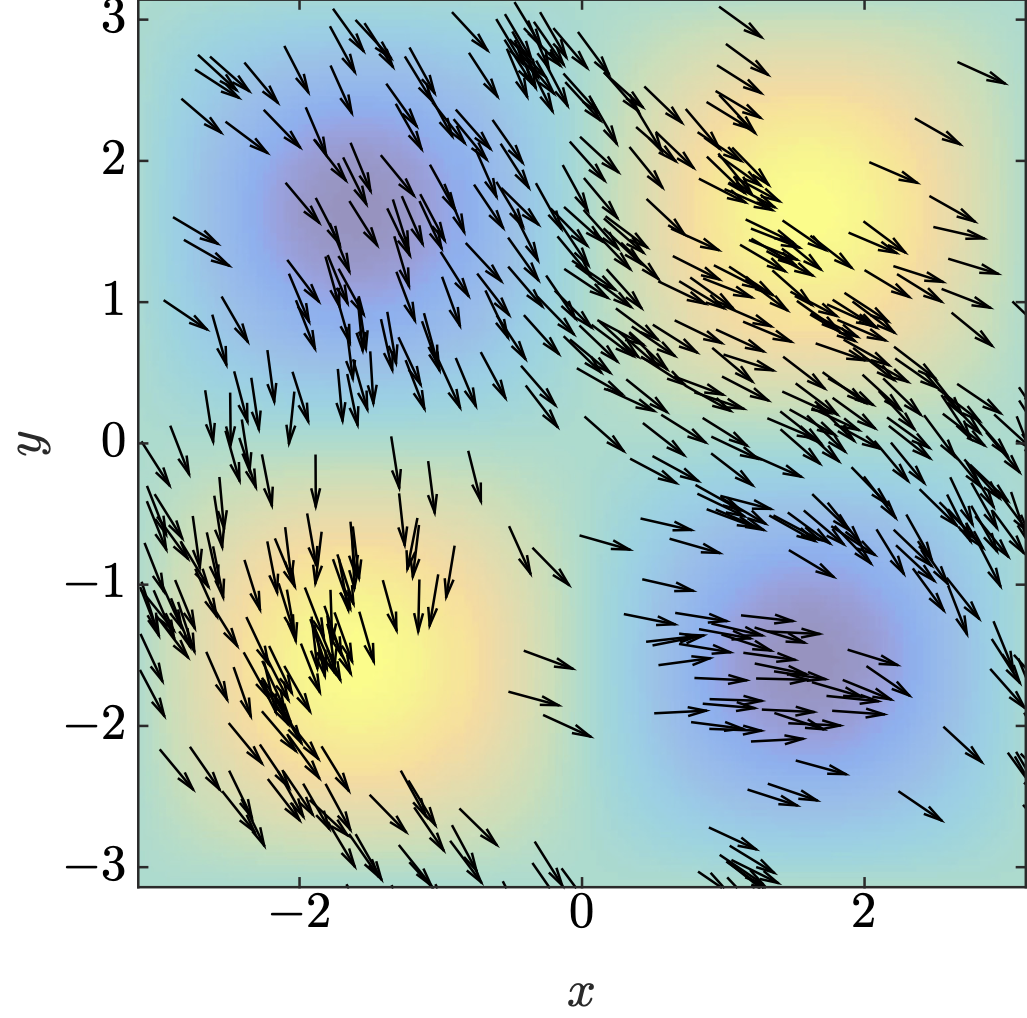
Anticipation in flocks
Collective animal motion produces some of the most spectacular displays the natural world has to offer, from rotating ant colonies and starling murmurations to wildebeest stampeding across the savannah. One of the most widely used models of flocking is the Vicsek model, an agent-based approach in which each organism is a point that aligns with its neighbours. Flocking in this model is robust to noise that is uncorrelated in space and time, but a study by Khurana and Ouellette showed that spatiotemporally correlated noise strongly affects whether Vicsek flocks can form. Schools of fish and flocks of birds clearly form in turbulent environments, so the alignment mechanism deserves another look.
In a paper published in 2016, I showed that combining alignment with local neighbours and anticipation of their motion allows flocks to persist in vortical fluid flow. The primary motivation is understanding the interactions within animal groups, but there may also be applications to the design of flocking autonomous drones and artificial microswimmers.
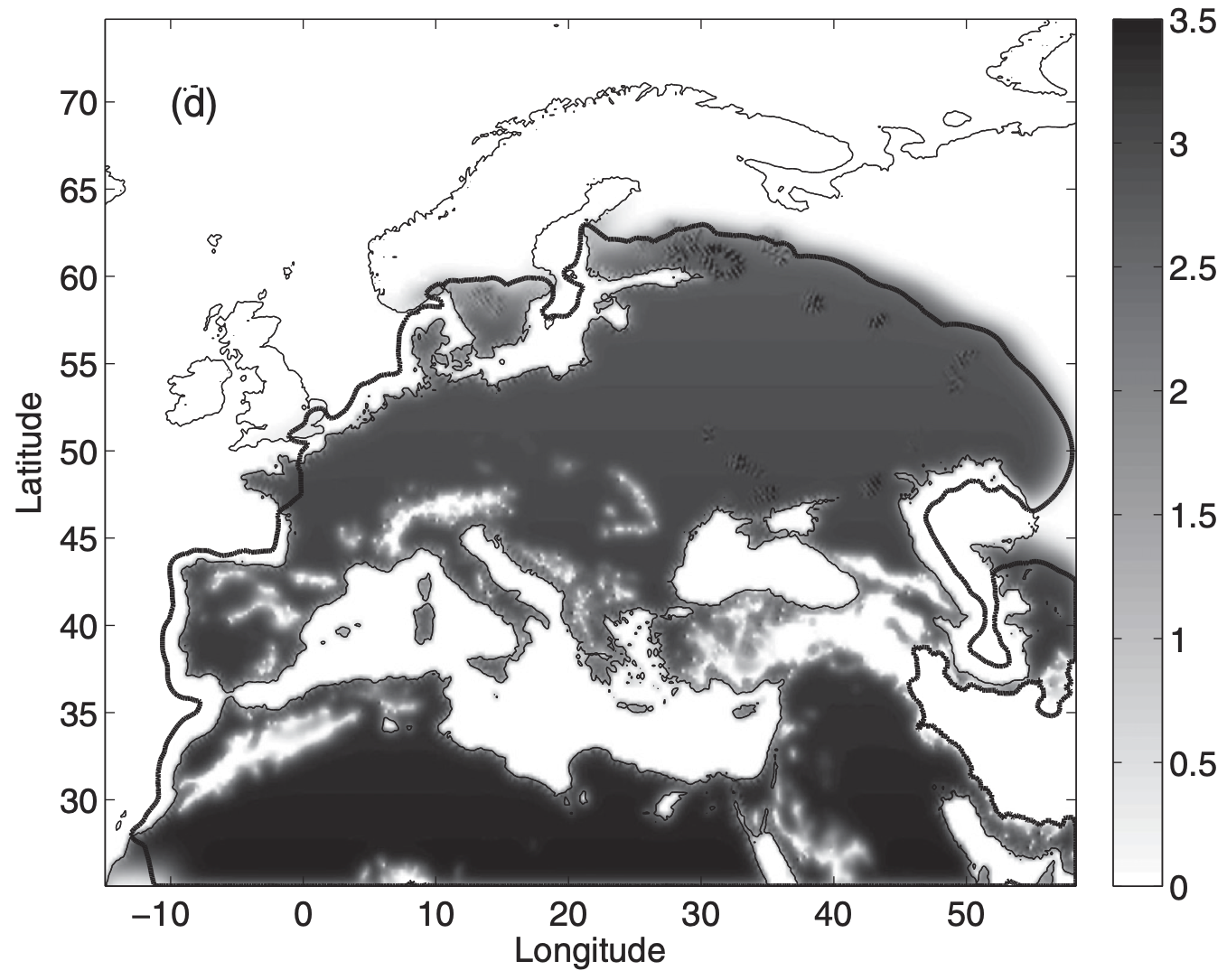
Neolithic riverways
The transition to the Neolithic was a crucial period in the development of Eurasian societies, defining much of their subsequent evolution. The introduction of agro-pastoral farming, which originated in the Near East around 12,000 years ago and then spread throughout Europe, is a defining feature of this transition. In a series of papers we developed a mathematical and statistical framework to understand the role of waterways in the spread of farming into western Europe. Our results confirmed several conclusions of earlier studies: an accelerated spread along the western Mediterranean coast, a modest acceleration in the eastern Mediterranean, and enhanced spread in the Danube–Rhine corridor. These findings help build a global picture of the emergence of farming across Europe.
Publications in this theme
M. Dopson, N. G. Parker, L. E. Wadkin, A. W. Baggaley, R. J. Pakeman, S. W. Smith, and D. M. Evans. The impacts of grazing pressure by large herbivores on short-tailed field vole (Microtus agrestis) population cycles: results from a long-term upland experiment. In submission (2026).
BibTeX
@misc{dopson2026impacts, title = {The impacts of grazing pressure by large herbivores on short-tailed field vole (Microtus agrestis) population cycles: results from a long-term upland experiment}, author = {M. Dopson and N. G. Parker and L. E. Wadkin and A. W. Baggaley and R. J. Pakeman and S. W. Smith and D. M. Evans}, year = {2026}, note = {in submission}, }J. S. Bains, A. W. Baggaley, and O. A. Croze. Drift velocity of bacterial chemotaxis in dynamic chemical environments. Philosophical Transactions of the Royal Society A (2025).
BibTeX
@article{bains2025drift, title = {Drift velocity of bacterial chemotaxis in dynamic chemical environments}, author = {J. S. Bains and A. W. Baggaley and O. A. Croze}, journal = {Philosophical Transactions of the Royal Society A}, year = {2025}, }S. R. Quick, J. S. Bains, C. Gerdt, B. Walker, E. B. Goldstone, T. Jakuszeit et al. A close unicellular animal relative and predator of schistosomes exhibits chemokinesis in response to proteins and peptides from its prey. PLoS Pathogens 21, e1013440 (2025).
DOIBibTeX
@article{quick2025close, title = {A close unicellular animal relative and predator of schistosomes exhibits chemokinesis in response to proteins and peptides from its prey}, author = {S. R. Quick and J. S. Bains and C. Gerdt and B. Walker and E. B. Goldstone and T. Jakuszeit and others}, journal = {PLoS Pathogens}, volume = {21}, pages = {e1013440}, year = {2025}, doi = {10.1371/journal.ppat.1013440}, }L. E. Wadkin, J. Holden, R. Ettelaie, M. J. Holmes, J. Smith, A. Golightly, and A. W. Baggaley. Estimating the reproduction number, R₀, from individual-based models of tree disease spread. Ecological Modelling 489, 110630 (2024).
BibTeX
@article{wadkin2024estimating, title = {Estimating the reproduction number, R₀, from individual-based models of tree disease spread}, author = {L. E. Wadkin and J. Holden and R. Ettelaie and M. J. Holmes and J. Smith and A. Golightly and A. W. Baggaley}, journal = {Ecological Modelling}, volume = {489}, pages = {110630}, year = {2024}, }A. Golightly, L. E. Wadkin, S. Whitaker, A. W. Baggaley, N. G. Parker, and T. Kypraios. Accelerating Bayesian inference for stochastic epidemic models using incidence data. Statistics and Computing 33, 134 (2023).
BibTeX
@article{golightly2023accelerating, title = {Accelerating Bayesian inference for stochastic epidemic models using incidence data}, author = {A. Golightly and L. E. Wadkin and S. Whitaker and A. W. Baggaley and N. G. Parker and T. Kypraios}, journal = {Statistics and Computing}, volume = {33}, pages = {134}, year = {2023}, }H. Kreczak, A. W. Baggaley, and A. J. Willmott. The dynamics of biofouled particles in vortical flows. Marine Pollution Bulletin 189, 114729 (2023).
PDFBibTeX
@article{kreczak2023dynamics, title = {The dynamics of biofouled particles in vortical flows}, author = {H. Kreczak and A. W. Baggaley and A. J. Willmott}, journal = {Marine Pollution Bulletin}, volume = {189}, pages = {114729}, year = {2023}, }L. E. Wadkin, A. Golightly, J. Branson, A. Hoppit, N. G. Parker, and A. W. Baggaley. Quantifying invasive pest dynamics through inference of a two-node epidemic network model. Diversity 15, 496 (2023).
BibTeX
@article{wadkin2023quantifying, title = {Quantifying invasive pest dynamics through inference of a two-node epidemic network model}, author = {L. E. Wadkin and A. Golightly and J. Branson and A. Hoppit and N. G. Parker and A. W. Baggaley}, journal = {Diversity}, volume = {15}, pages = {496}, year = {2023}, }L. E. Wadkin, J. Branson, A. Hoppit, N. G. Parker, A. Golightly, and A. W. Baggaley. Inference for epidemic models with time-varying infection rates: tracking the dynamics of oak processionary moth in the UK. Ecology and Evolution 12, e8871 (2022).
PDFDOIbioRxivBibTeX
@article{wadkin2022inference, title = {Inference for epidemic models with time-varying infection rates: tracking the dynamics of oak processionary moth in the UK}, author = {L. E. Wadkin and J. Branson and A. Hoppit and N. G. Parker and A. Golightly and A. W. Baggaley}, journal = {Ecology and Evolution}, volume = {12}, pages = {e8871}, year = {2022}, doi = {10.1002/ece3.8871}, }H. Kreczak, A. J. Willmott, and A. W. Baggaley. Subsurface dynamics of buoyant microplastics subject to algal biofouling. Limnology and Oceanography 66, 3287–3299 (2021).
PDFBibTeX
@article{kreczak2021subsurface, title = {Subsurface dynamics of buoyant microplastics subject to algal biofouling}, author = {H. Kreczak and A. J. Willmott and A. W. Baggaley}, journal = {Limnology and Oceanography}, volume = {66}, pages = {3287--3299}, year = {2021}, }S. Orozco-Fuentes, L. E. Wadkin, I. Neganova, M. Lako, R. A. Barrio-Paredes, A. W. Baggaley, N. G. Parker, and A. Shukurov. OCT4 expression in human embryonic stem cells: spatio-temporal dynamics and fate transitions. Physical Biology 18, 026003 (2021).
PDFbioRxivBibTeX
@article{orozcofuentes2021oct4, title = {OCT4 expression in human embryonic stem cells: spatio-temporal dynamics and fate transitions}, author = {S. Orozco-Fuentes and L. E. Wadkin and I. Neganova and M. Lako and R. A. Barrio-Paredes and A. W. Baggaley and N. G. Parker and A. Shukurov}, journal = {Physical Biology}, volume = {18}, pages = {026003}, year = {2021}, }S. Orozco-Fuentes, I. Neganova, L. E. Wadkin, A. W. Baggaley, R. A. Barrio, M. Lako, A. Shukurov, and N. G. Parker. Quantification of the morphological characteristics of hESC colonies. Scientific Reports 9 (2019).
PDFarXivDOIBibTeX
@article{orozcofuentes2019quantification, title = {Quantification of the morphological characteristics of hESC colonies}, author = {S. Orozco-Fuentes and I. Neganova and L. E. Wadkin and A. W. Baggaley and R. A. Barrio and M. Lako and A. Shukurov and N. G. Parker}, journal = {Scientific Reports}, volume = {9}, year = {2019}, doi = {10.1038/s41598-019-53719-9}, eprint = {1905.07279}, archivePrefix = {arXiv}, }F. Carrer, G. R. Sarson, A. W. Baggaley, A. Shukurov, and D. E. Angelucci. Ethnoarchaeology-based modelling to investigate economic transformations and land-use change in the Alpine uplands. Integrating Qualitative and Social Science Factors in Archaeological Modelling (Springer), 185–216 (2019).
PDFBibTeX
@incollection{carrer2019ethnoarchaeologybased, title = {Ethnoarchaeology-based modelling to investigate economic transformations and land-use change in the Alpine uplands}, author = {F. Carrer and G. R. Sarson and A. W. Baggaley and A. Shukurov and D. E. Angelucci}, booktitle = {Integrating Qualitative and Social Science Factors in Archaeological Modelling (Springer)}, pages = {185--216}, year = {2019}, }S. Orozco-Fuentes, G. Griffiths, M. J. Holmes, R. Ettelaie, J. Smith, A. W. Baggaley, and N. G. Parker. Early warning signals in plant disease outbreaks. Ecological Modelling 393, 12–19 (2019).
PDFarXivBibTeX
@article{orozcofuentes2019early, title = {Early warning signals in plant disease outbreaks}, author = {S. Orozco-Fuentes and G. Griffiths and M. J. Holmes and R. Ettelaie and J. Smith and A. W. Baggaley and N. G. Parker}, journal = {Ecological Modelling}, volume = {393}, pages = {12--19}, year = {2019}, eprint = {1802.07562}, archivePrefix = {arXiv}, }S. I. Heath-Richardson, A. W. Baggaley, and N. A. Hill. Gyrotaxis suppresses chaotic trajectories of swimming particles in three-dimensional flows. Physical Review Fluids 3, 023102 (2018).
PDFDOIBibTeX
@article{heathrichardson2018gyrotaxis, title = {Gyrotaxis suppresses chaotic trajectories of swimming particles in three-dimensional flows}, author = {S. I. Heath-Richardson and A. W. Baggaley and N. A. Hill}, journal = {Physical Review Fluids}, volume = {3}, pages = {023102}, year = {2018}, doi = {10.1103/PhysRevFluids.3.023102}, }A. W. Baggaley. Stability of model flocks in a vortical flow. Physical Review E 93, 063109 (2016).
A. W. Baggaley. Model flocks in a steady vortical flow. Physical Review E 91, 053019 (2015).
D. A. Henderson, A. W. Baggaley, A. Shukurov, R. J. Boys, G. R. Sarson, and A. Golightly. Regional variations in the European Neolithic dispersal: the role of the coastlines. Antiquity 88, 1291–1302 (2014).
PDFBibTeX
@article{henderson2014regional, title = {Regional variations in the European Neolithic dispersal: the role of the coastlines}, author = {D. A. Henderson and A. W. Baggaley and A. Shukurov and R. J. Boys and G. R. Sarson and A. Golightly}, journal = {Antiquity}, volume = {88}, pages = {1291--1302}, year = {2014}, }A. W. Baggaley, R. J. Boys, G. R. Sarson, A. Golightly, and A. Shukurov. Inference for a reaction–diffusion model of population dynamics in the Neolithic period. The Annals of Applied Statistics 6, 1352–1376 (2012).
PDFarXivBibTeX
@article{baggaley2012inference, title = {Inference for a reaction–diffusion model of population dynamics in the Neolithic period}, author = {A. W. Baggaley and R. J. Boys and G. R. Sarson and A. Golightly and A. Shukurov}, journal = {The Annals of Applied Statistics}, volume = {6}, pages = {1352--1376}, year = {2012}, eprint = {1301.1525}, archivePrefix = {arXiv}, }A. W. Baggaley, G. R. Sarson, A. Shukurov, R. J. Boys, and A. Golightly. Bayesian inference for a wavefront model of the Neolithization of Europe. Physical Review E 86, 016105 (2012).
PDFarXivDOIBibTeX
@article{baggaley2012bayesian,
  title = {Bayesian inference for a wavefront model of the Neolithization of Europe},
  author = {A. W. Baggaley and G. R. Sarson and A. Shukurov and R. J. Boys and A. Golightly},
  journal = {Physical Review E},
  volume = {86},
  pages = {016105},
  year = {2012},
  doi = {10.1103/PhysRevE.86.016105},
  eprint = {1203.4471},
  archivePrefix = {arXiv},
}